
Search for the best Christmas markets in Europe and you’ll usually see the same cities again and again.
Vienna. Strasbourg. Prague. Nuremberg. Cologne.
And there is absolutely nothing wrong with any of them.
But if you ask me, some of the most interesting festive city breaks are often the ones that sit just outside the usual Christmas-market conversation.
So instead of repeating the most obvious names, I wanted to focus on six places that I think deserve a bit more attention.
I’m not saying market number one is better than market number six.
I’ve chosen these because they combine Christmas atmosphere with cities I’d actually want to visit anyway.
I’ve also added approximate 2025 prices for mulled wine and something typical to eat. Local prices are shown first, with approximate euro equivalents where another currency is used.
And there is another question I think Christmas-market articles often forget completely:
What are you supposed to do for the rest of the trip once you’ve finished looking at the market?
Realistically, you are probably not going to spend 48 hours continuously drinking mulled wine and inspecting handmade Christmas decorations.
Well... hopefully not.
So for every city below I’ve also included what I’d do once you’ve had enough of the market itself.
It shouldn’t have to be the entire city break.
Sibiu might be the one on this list that surprises people the most.
The market takes over Piața Mare, the enormous central square in one of Transylvania’s prettiest cities, and visually it is almost unfair how well the place lends itself to Christmas.
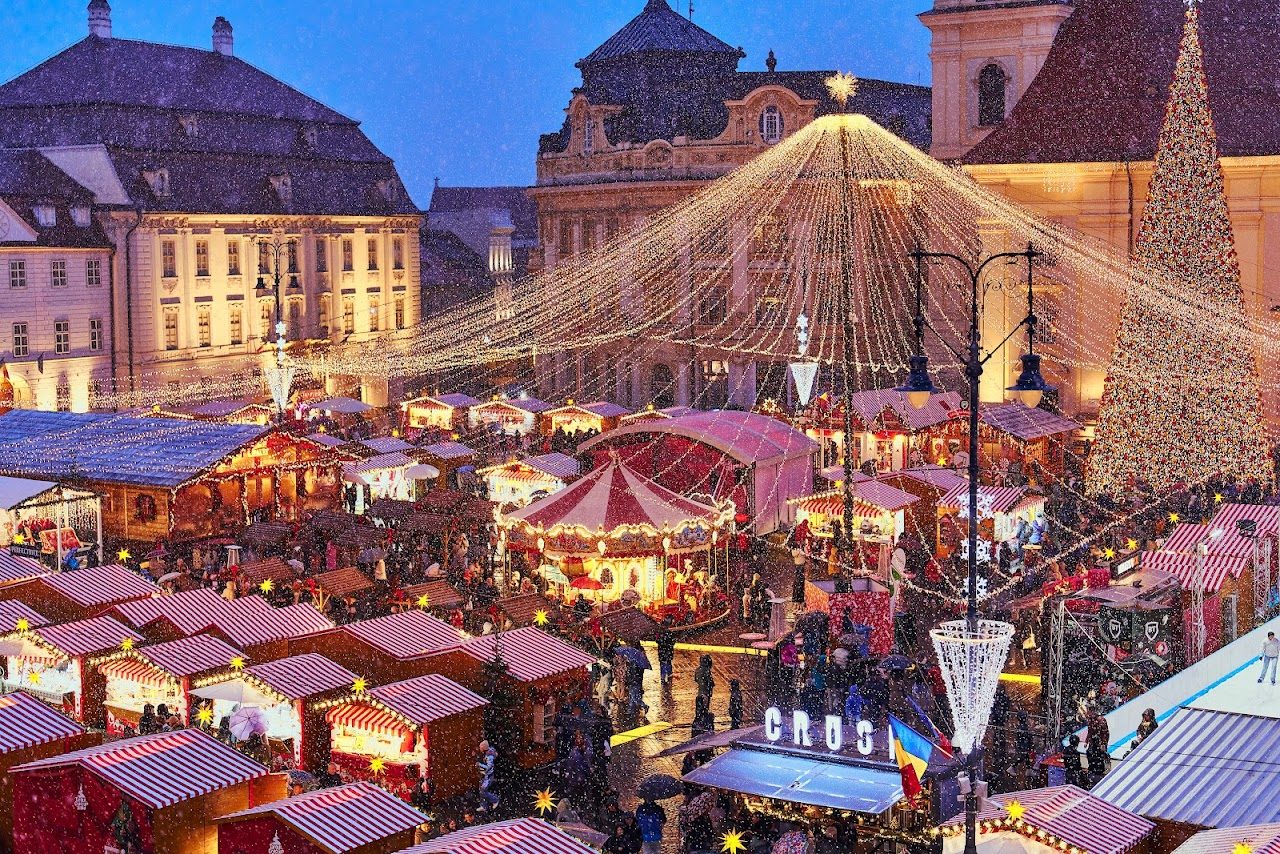
Curtains of lights stretch across the square, the colourful historic facades glow after dark and the stalls sit underneath some of the most distinctive architecture in Romania.
Sibiu is one of those places where the setting does half the work.
Even without a Christmas market, the historic centre has enough narrow passages, medieval towers, cobbled lanes and slightly eccentric architecture to keep you wandering around for hours.
Then there are those famous roofs.
Many of the old houses have eyebrow-shaped ventilation windows that make the buildings look as though they are quietly watching you walk underneath them.
Slightly creepy? Yes.
Extremely photogenic? Also yes.
Food-wise, sarmale would be the obvious local thing for me to try — cabbage leaves stuffed with meat and rice and exactly the sort of heavy winter food that starts making much more sense when the temperature drops.
Add a glass of vin fiert for roughly €3 and Sibiu also remains considerably easier on the wallet than many of the famous Western European markets.
Start by walking from Piața Mare into Piața Mică and across the Bridge of Lies, then drop into the Lower Town rather than staying only around the main square.
I’d also climb one of the central viewpoints if the weather is clear. Seeing the red roofs of Sibiu with the Carpathians in the distance would probably be one of the highlights of the trip.
If the weather turns horrible, this is also a city where you can retreat indoors rather than giving up completely. The Brukenthal Museum gives you an obvious cultural option in the historic centre.
With an extra half-day, I’d look at the ASTRA Museum outside the centre — a huge open-air museum of traditional Romanian rural architecture. Just check the winter opening schedule before going.
Calling Gdańsk completely under the radar is becoming more difficult every year.
The secret is definitely getting out.
But ask the average traveller in Western Europe to name five Christmas-market destinations and I still doubt Gdańsk appears very often.
And it probably should.
The Christmas market gives you a much bigger event than some of the smaller destinations on this list, with food, decorations, stalls and entertainment spread through the historic centre.
But what really sells Gdańsk to me is that Christmas is almost a bonus.
This is already one of Poland’s most interesting city breaks.
The reconstructed historic centre feels completely different from Kraków or Warsaw, the waterfront gives the city a strong maritime identity, and the colourful facades along the Long Market look particularly good once the winter lights come on.
Then there’s the food.
A portion of pierogi for roughly €4–6 followed by mulled wine for around €3–4 is still a relatively painless Christmas-market evening by European standards.
Walk the Long Market and Royal Route, explore the waterfront and give yourself time to look beyond the decorative centre.
Gdańsk is particularly strong if you like history. The Museum of the Second World War is a substantial visit rather than something I’d squeeze into 45 minutes, while the European Solidarity Centre covers the Solidarity movement and the collapse of communism in Eastern Europe.
If you want something lighter, the Amber Museum makes perfect sense in a city so closely associated with Baltic amber.
And if you have a third day, jump on the local train to Sopot. You can combine a Christmas trip with a walk beside the Baltic Sea, which is perhaps not the first thing people imagine doing in Poland in December — but that’s part of the appeal.
Ljubljana might be my favourite conceptually.
Not because it has Europe’s biggest Christmas market.
Quite the opposite.
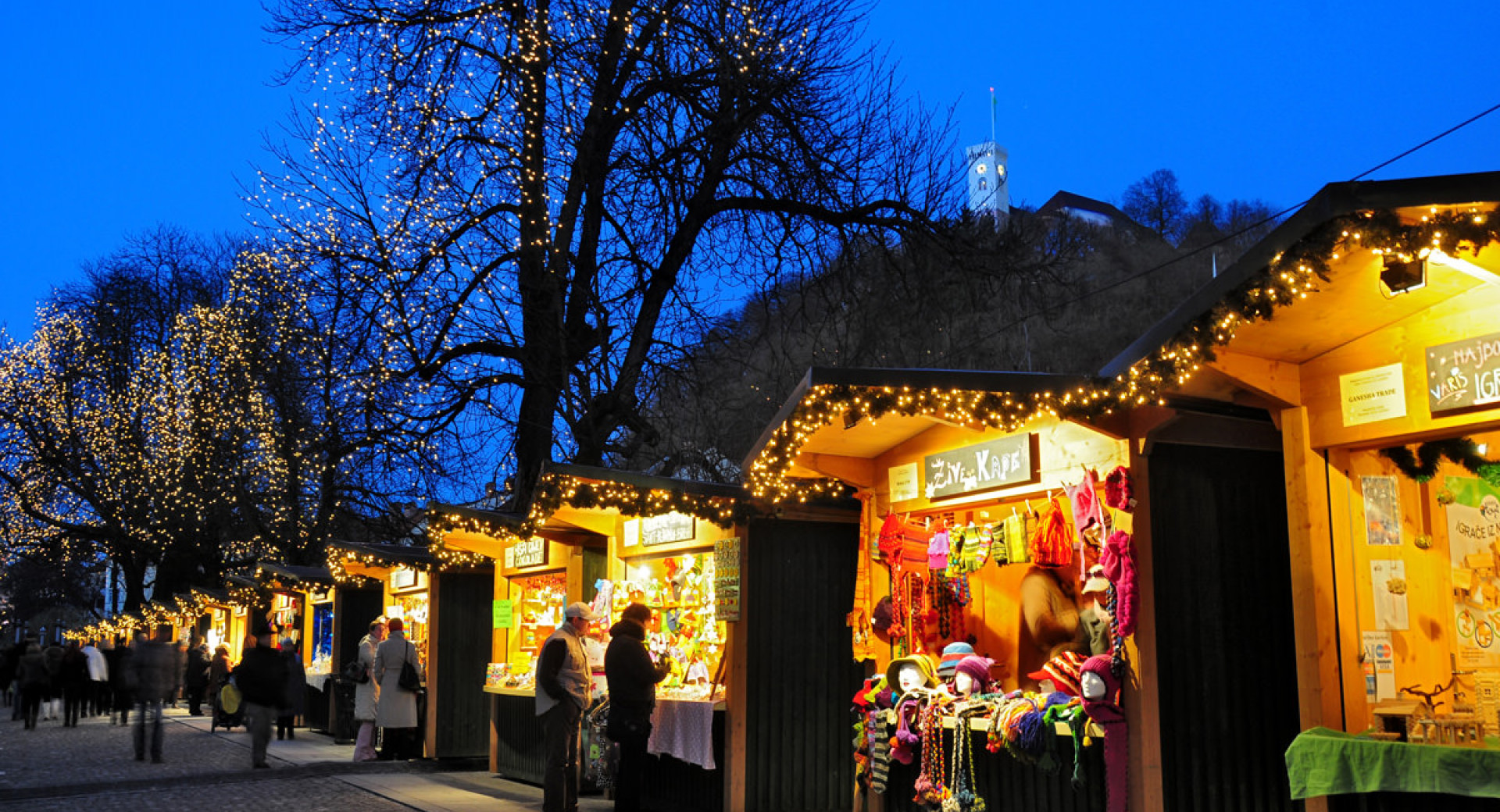
Ljubljana works because the entire centre becomes part of the festive experience.
Stalls appear along the Ljubljanica River and around the surrounding squares, meaning you can wander through the city rather than simply entering one market, doing a lap and leaving.
Cross one bridge, stop for a drink, keep walking, find another group of stalls.
That’s much more my type of Christmas market.
The city is also compact enough that a two-night visit doesn’t feel like a military operation.
You can walk almost everywhere in the centre, which means more time actually seeing Ljubljana and less time staring at a transport app wondering why your tram has disappeared.
Food-wise, Kranjska klobasa is the easy recommendation: Slovenia’s famous Carniolan sausage, normally served with bread, mustard or sauerkraut.
Take the funicular up to Ljubljana Castle. The castle has watched over the city for centuries, and from the hill you get the perspective that is missing when you spend the entire trip beside the river.
Back below, walk the Triple Bridge, Dragon Bridge and the old streets around Town Square. This is a city where simply walking without much of a plan works surprisingly well.
I’d also visit the Central Market. It is not just a tourist attraction — it remains part of everyday Ljubljana and is an easy place to look for Slovenian food and local produce.
If you have more time, escape the very compact centre for a walk through Tivoli Park, or spend the evening exploring Ljubljana’s bars and restaurants rather than consuming your fourth cup of mulled wine purely because you can.
Austria and Christmas markets normally means one thing internationally: Vienna.
Maybe Salzburg if people are feeling adventurous.
Graz somehow gets left behind.
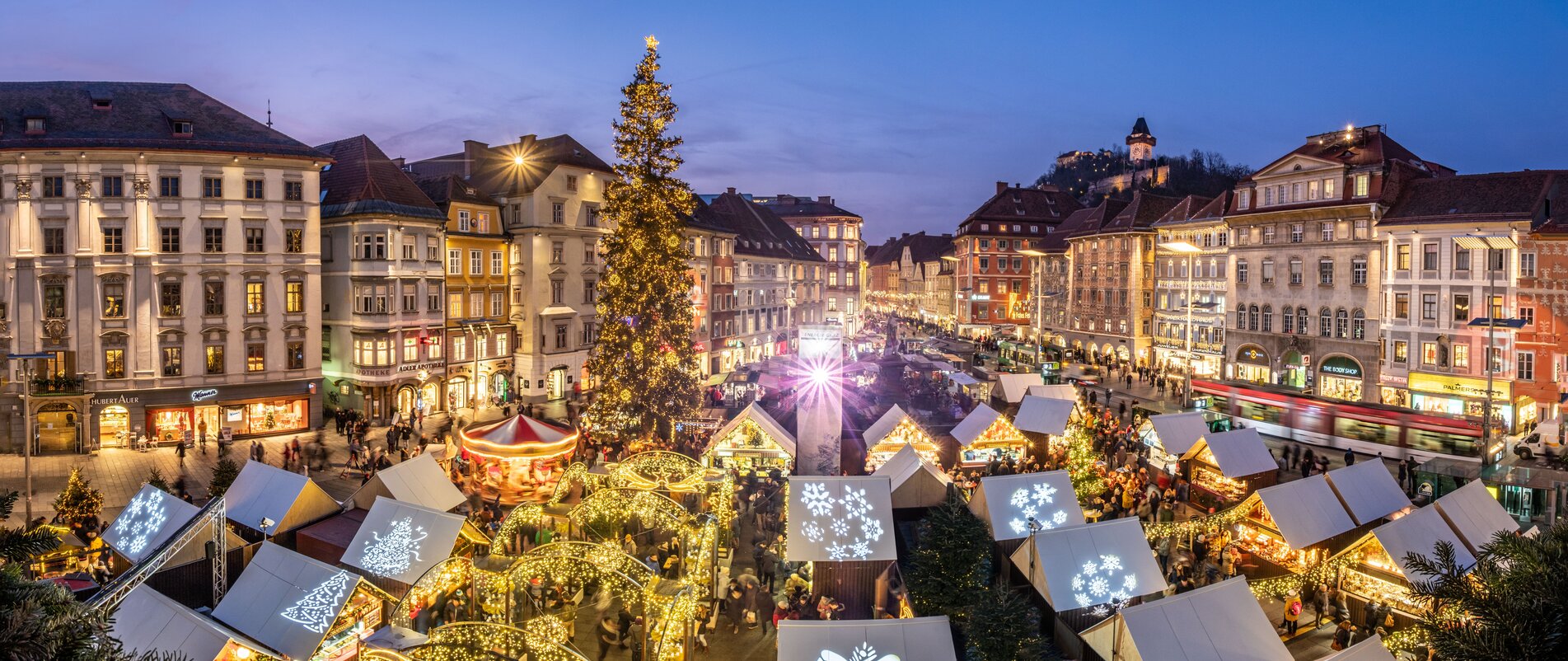
And I think that’s a shame, because Graz has something that works especially well for a short Christmas trip: several different markets within a very compact centre.
Instead of visiting one enormous market, you can move between Hauptplatz, the Franziskanerviertel and the smaller surrounding Advent areas.
That gives the evening a bit of variety.
Different stalls, different atmosphere, different drink... and eventually the same conversation about whether you really need another Käsekrainer.
Graz also feels different enough from Vienna to justify the trip.
It has an attractive historic centre but also much more contemporary architecture, a large student population and a strong food scene.
And because this is Styria, you can also expect plenty of regional products rather than everything feeling completely generic.
Go up the Schlossberg to the Clock Tower. You can walk, use the lift or take the funicular, and the reward is one of the best views across Graz.
Then decide which version of Graz you want. For history, the Styrian Armoury contains an extraordinary collection of historic weapons and armour. For something completely different, head to the futuristic Kunsthaus beside the Mur.
You can also cross the river via the Murinsel, wander around the Lend district, or simply spend an afternoon eating your way through the city.
Eggenberg Palace is another major attraction if your schedule and its winter opening times line up.
Vilnius is another one where I suspect the under-the-radar status won’t last forever.
The city has become particularly good at one piece of Christmas marketing: the tree.

Vilnius has repeatedly produced elaborate Christmas-tree designs that get shared all over Europe, and the market below it in Cathedral Square makes a pretty spectacular centrepiece.
But Vilnius works for me because there is far more around it.
The Old Town is large enough to spend hours exploring but compact enough to remain walkable, while Baroque churches, little courtyards and cobbled streets give the city a completely different look from the Nordic capitals further north.
There is also something to be said for travelling somewhere in December where winter has at least a reasonable chance of behaving like winter.
Christmas lights under snow?
Excellent.
Christmas lights reflecting off horizontal rain at 11°C?
Slightly less magical.
Climb Gediminas Hill and, if it is open during your visit, go into Gediminas’ Tower for one of the classic panoramas over the red roofs of Vilnius.
Then wander into Užupis, the city’s small bohemian district across the Vilnelė River. It feels quite different from Cathedral Square and is an easy addition to an Old Town walk.
For indoor options, you have the Palace of the Grand Dukes, the contemporary MO Museum and the much heavier Museum of Occupations and Freedom Fights.
And if you have a third day, Trakai is the obvious escape from Vilnius. Its island castle makes a very different day out, and it also gives you an excellent excuse to try more kibinai.
And finally, something Italian.
Except Bolzano at Christmas doesn’t feel entirely Italian.
Which is exactly the point.
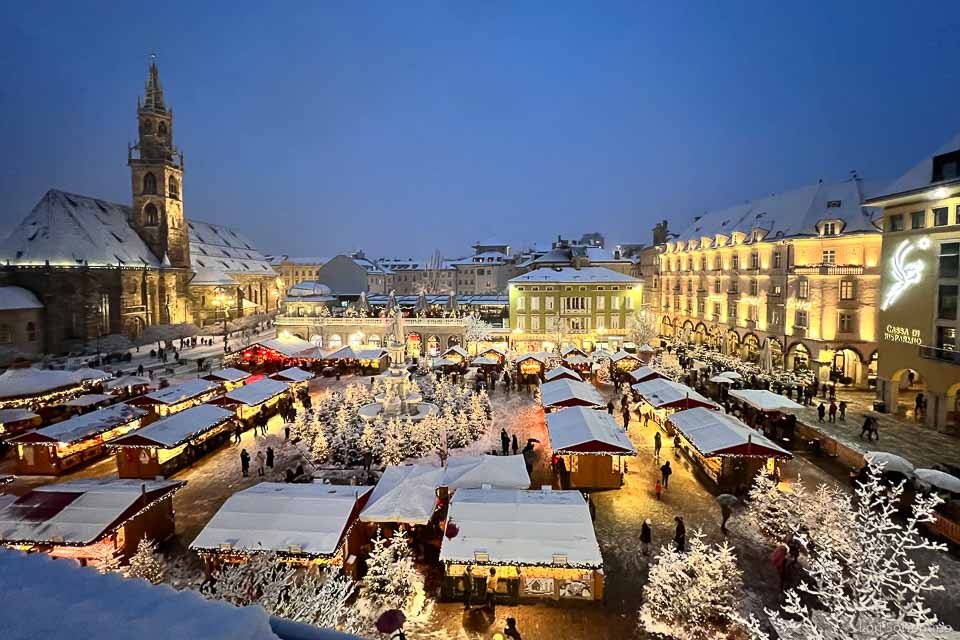
Bolzano sits in South Tyrol, where Italian and Austrian cultures overlap underneath the mountains.
German and Italian are both part of everyday life, the architecture feels Alpine and the food happily ignores the border altogether.
That means you can essentially combine an Austrian-style Christmas market with an Italian food trip.
I see absolutely no problem with this arrangement.
Piazza Walther forms the centre of the market, while the surrounding historic streets and arcades give you somewhere to wander once you’ve worked your way through the stalls.
And food might be the strongest reason to choose Bolzano over some of the more famous markets.
Speck, sausages, apple strudel, local wine, pastries, dumplings and Alpine cheeses are all much more interesting to me than eating exactly the same generic Christmas-market food in six different countries.
I’d go for Knödel — or canederli in Italian — because few dishes make more sense when it is freezing outside.
First stop: the South Tyrol Museum of Archaeology, home to Ötzi the Iceman. Seeing a naturally preserved man who died more than 5,000 years ago is a fairly convincing way of proving that your weekend does not need to revolve entirely around mulled wine.
Then explore the old town and the covered Lauben arcades, where you’ll find shops, cafés and the mix of Austrian and Italian influences that makes Bolzano unusual.
If visibility is good, I’d seriously consider the Renon/Ritten cable car. It takes you out of the city and onto the plateau above Bolzano, where you can continue using the historic narrow-gauge railway and get proper mountain scenery.
With another day available, you could also use Bolzano as a base to explore more of South Tyrol rather than treating it as a market-only destination.
That depends entirely on what kind of weekend you want.
Sibiu if you want the fairytale setting.
Gdańsk if you want a larger Christmas market combined with serious sightseeing.
Ljubljana if you want a romantic, compact and ridiculously easy city break.
Graz if you like hopping between several different markets rather than staying in one.
Vilnius if winter atmosphere, lights and an interesting Old Town are your priority.
And Bolzano if food and mountain scenery are secretly more important to you than Christmas itself.
after you’ve finished the mulled wine.
Christmas markets are seasonal events, so dates, opening hours and individual attractions can still change.
I would always double-check the official market website before booking anything non-refundable.
I’d also avoid assuming every market continues through Christmas itself. Some finish before 24 December, while others carry on into January.
The same applies to museums, cable cars and attractions around the city. Winter schedules can be different, particularly around Christmas Eve, Christmas Day and New Year.
If you have flexibility, I’d often choose Sunday to Thursday instead of Friday or Saturday.
You’ll usually get the same lights, the same mulled wine and considerably fewer people standing between you and both of them.
And when choosing a hotel, I’d pay a little extra to stay within walking distance of the historic centre. Being able to wander back to your hotel after the market instead of figuring out public transport in freezing weather is worth something.
I have nothing against Europe’s most famous Christmas markets.
Vienna is beautiful. Prague is beautiful. Strasbourg has practically turned Christmas into an industry.
But I do think too many Christmas-market lists forget that you are travelling to an actual city, not just a collection of wooden huts.
Sibiu, Gdańsk, Ljubljana, Graz, Vilnius and Bolzano all give you proper festive atmosphere while still giving you plenty to do during the other 20 hours of the day.
And that matters.
I don’t want to fly somewhere purely because it has Christmas lights.
I want somewhere I’d genuinely enjoy visiting anyway — then let the Christmas market make the trip even better.
For history, I’d probably lean towards Gdańsk.
For an easy romantic weekend, Ljubljana.
For food and mountains, Bolzano.
But if I had to choose the one that feels most under my own radar?
Sibiu would be very difficult to ignore.
More winter inspiration and smarter ways to plan your next trip.


